
Every hardware company wants to accelerate product development. Engineering teams invest in better CAD tools, simulation software, rapid prototyping, and agile development methodologies to shorten design cycles and bring innovative products to market faster.
Yet many projects still experience costly delays, not because the design wasn’t innovative, or the engineering wasn’t sound, but because the transition from design to manufacturing wasn’t managed effectively.
The reality is that designing a product and building a product are two very different challenges. The handoff between those phases, often referred to as design transfer, is one of the most overlooked aspects of hardware development. When executed well, it is nearly invisible. When executed poorly, it can derail schedules, increase costs, and delay product launches by weeks or even months.
Cross-Functional Collaboration Is an Engineering Capability
As products become more sophisticated, successful development depends on more than technical expertise within individual disciplines.
Mechanical, electrical, firmware, manufacturing, sourcing, quality, and project management all contribute to a product’s success. Unfortunately, these groups often operate independently, communicating primarily through formal handoffs instead of continuous collaboration.
The result is predictable: information gaps, duplicated work, delayed decisions, and avoidable rework.
High-performing product development organizations recognize that collaboration is not simply a management practice. It is an engineering capability. They establish shared processes, common documentation, and regular communication that keep every team aligned from concept through production.
When engineers understand supplier constraints, procurement understands design priorities, and manufacturing provides feedback before designs are finalized; projects move more efficiently and with fewer surprises.
Why Hardware Projects Really Fall Behind
When product schedules slip, organizations often point to supply chain disruptions or unexpected technical issues. While those challenges certainly exist, many delays originate much earlier in the development process.
Consider a common scenario.
Engineering releases a preliminary BOM. Procurement begins requesting supplier quotes. A few weeks later, engineers make design revisions that change several components. Purchase orders must be revised, suppliers need updated drawings, lead times change, and manufacturing documentation must be updated. Individually, each change seems minor. Collectively, they introduce uncertainty that compounds throughout the project.
Multiply this across dozens or even hundreds of components, and the result is an increasingly difficult project to manage.
The strongest engineering organizations minimize these disruptions by establishing disciplined release processes, maintaining clear ownership of documentation, and ensuring every stakeholder is working from the same source of truth.
The BOM Is More Than a Purchasing Tool
Many people think of the bill of materials (BOM) as simply a list of parts for purchasing.
In reality, the BOM is one of the most important communication tools in the entire product development process.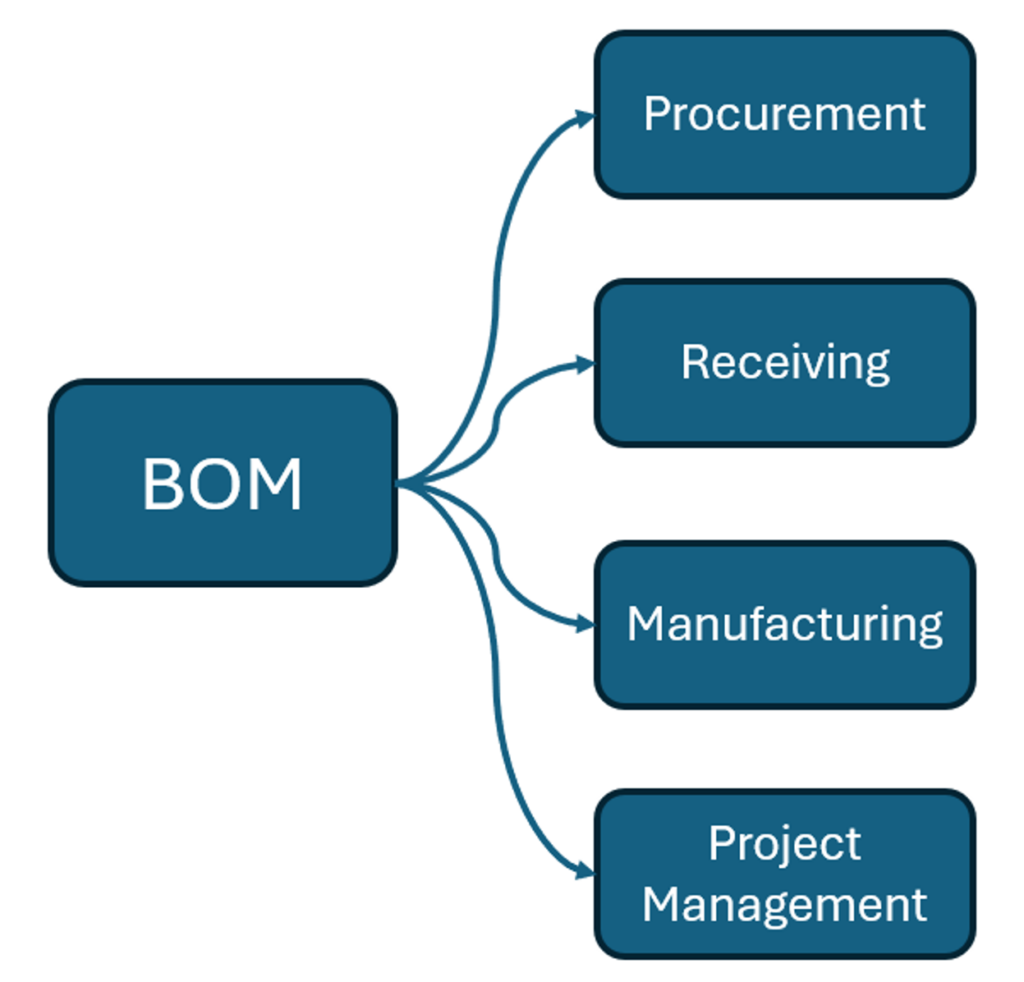
Engineering relies on it to define product structure. Procurement uses it to obtain supplier quotes and issue purchase orders. Receiving uses it to verify deliveries and inventory. Manufacturing references it during assembly. Project managers depend on it to understand schedule risk and build readiness.
When teams share a centralized, continuously updated BOM, information flows much more efficiently. Supplier quotes, delivery dates, inventory status, engineering changes, and purchasing activity remain synchronized instead of being tracked in disconnected spreadsheets and email threads.
This level of visibility enables project teams to identify potential delays early, while there is still time to respond, rather than discovering problems when production is ready to begin.
Managing Long-Lead Components Before They Become Schedule Risks
Supply chain volatility has made long-lead components one of the biggest scheduling risks in modern hardware development.
Waiting until every detail of a design is finalized before initiating procurement may seem like a safe approach, but it often creates unnecessary delays.
Instead, experienced product development teams identify long-lead components early and lock down their interfaces early. By locking down the portions of the design that affect these critical components, purchasing can begin sourcing parts while the rest of the design continues to mature.
Designing for Manufacturing Means Designing for Success
Design for Manufacturability (DFM) has long been recognized as a best practice. Today, successful product development requires an even broader perspective.
Engineering teams must also design for procurement, design for assembly, design for testing, and design for supply chain resilience.
Every engineering decision has downstream consequences. Selecting a component with a 30-week lead time, overlooking assembly accessibility, or failing to communicate design intent can have a greater impact on a project’s schedule than the original engineering effort itself.
Organizations that recognize these downstream dependencies early are better equipped to reduce risk, improve predictability, and deliver successful products.
The Competitive Advantage Few Companies Talk About
The most successful hardware companies are not necessarily those with the largest engineering teams or the most advanced design tools. They are the organizations that consistently execute across the entire product development lifecycle.
A disciplined design transfer process, integrated BOM management, proactive procurement planning, and close collaboration between engineering and manufacturing rarely make headlines. Yet these operational practices often determine whether a product reaches the market on schedule or spends months overcoming preventable delays.
As hardware systems become increasingly complex and global supply chains continue to evolve, excellence in engineering will be measured not only by the quality of the design, but by how effectively that design is transformed into a manufacturable product.
Companies that treat design transfer as a strategic engineering discipline, not simply an administrative handoff, are better positioned to reduce development risk, accelerate time to market, and deliver innovative products with greater confidence.
At Simplexity, we believe successful product development extends far beyond creating a great design. By integrating engineering, procurement, manufacturing planning, and build support into a cohesive development process, we help clients reduce risk, improve visibility, and move from concept to production with greater confidence.
 Software: Design Complete
 Hardware: Pre-production units for design verification
 MFG. Readiness: CM schedule and budget, Unit build tracking