This is part of a series discussing some key high-level challenges of the hardware product development process and how to tackle those problems so that you can mature your design… Read More
FROM DEMO TO DONE: ENGINEERING HARDWARE THAT ACTUALLY SHIPS

| by Doug Harriman

This is part of a series discussing some key high-level challenges of the hardware product development process and how to tackle those problems so that you can mature your design… Read More
| by Doug Harriman

There are many companies exploring AI in mechanical design in 2026. Before we jump into generative design, let’s first acknowledge that AI can help with many aspects of the design… Read More
| by Doug Harriman

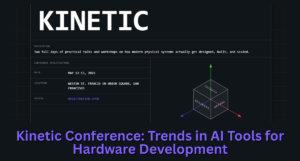
One of the most exciting parts of Hardware FYI’s Kinetic conference last week was the set of presentations from companies building AI tools for hardware development. Here are some of… Read More
| by Tony Mueller

Pulse Width Modulation (PWM) sits at the heart of many motor control implementations, from simple DC speed control to the precise step timing required by modern stepper drivers. While generating… Read More
| by Andrew Gosline

Piezoelectric materials have long played an essential role in modern electronics. Their defining property—the piezoelectric effect—allows specific crystalline and ceramic structures to convert mechanical stress into electrical charge, and conversely,… Read More
| by Michael Tanguay

The annual A3 Business Forum is a premier networking event for leaders across the automation and robotics industries, hosted by the Association for Advancing Automation (A3). This was my second… Read More

Robotics toys are no longer novelties. A growing number of consumer platforms now expose the same foundational subsystems engineers work with every day: electric actuators with feedback, multi-modal sensors, embedded… Read More
| by Michael Tanguay

The race to deploy humanoid robots at scale is accelerating, with shipment forecasts projected to reach 10,000-15,000 units by 20271 and production costs dropping up to 40% year-over-year2. Yet beneath… Read More
| by Tamsen Burlak

I recently attended RoboBusiness 2025, a gathering of robotics innovators, engineers, and industry leaders focused on the latest advances in AI, automation, and robotic technologies. The event offered a unique… Read More
| by Dorota Shortell

With the amount of attention given to robotics, humanoids, and physical AI, there are many new entrants and startups in the field. They often have great, even industry-changing ideas, but… Read More
The Simplexity team can be as involved in the production phase as requested by our clients. For clients with internal manufacturing or established relationships with contract manufacturers, our engineers are available to ensure quality is maintained and provide ongoing engineering support as needed.
Simplexity has a dedicated New Product Introduction (NPI) team that can guide the transition from design into production. The NPI team presents multiple options for manufacturing to the client, allowing clients to choose the solution that best suits their needs. This can involve Simplexity performing initial builds in-house prior to full handoff to a contract manufacturer or building the product via established relationships with contract manufacturing partners either domestically or overseas early in the process.
This phase occurs once the detailed design is complete, and prototypes are built with manufacturing-representative quality and detail. More extensive, formal testing is performed, such as life, reliability, safety, environmental, drop, and vibration.
The design team works closely with the manufacturing team to enable a smooth transfer, often with Simplexity engineers traveling to the contract manufacturer sites to ensure product quality. The design is transferred to the client based upon specific needs, most often after all tests are complete and the design is verified.
Phase 2C iterates on the learnings of Phase 2B and involves a refined prototype build of a fully integrated system. Some projects also benefit from additional iterations of the product based on prior learnings through additional phases (2D, 2E, etc), which are not represented in this graphic. All requirements are intended to be tested, and at the end of Phase 2 there will be confidence that the units will pass verification in Phase 3. The Bill of Materials is further refined, and the team updates estimates for the per unit cost of the product by receiving pricing from vendors and suppliers.
The detailed design phase usually has multiple, iterative sub-phases as the design progresses and representative prototypes are built. Phases 2B and 2C are typically the largest efforts in the product development process, where the specific implementation for all disciplines occurs (mechanical, industrial design, electrical, firmware, systems, software, manufacturing, and quality).
Simplexity typically engages with production component suppliers and contract manufacturing groups early in this phase to provide additional manufacturing input on the design. If the product has stringent testing or certification requirements, pre-screens are performed in this phase prior to formal regulatory agency testing.
Phase 0 is an optional phase for projects where the technical feasibility of the idea has not yet been fully proven. It can consist of research, concept work, exploring initial architecture, performing feasibility studies, and basic prototyping and testing.
The business and user requirements are converted into engineering requirements for the product. The project planning activity is based on the schedule, budget, risk, and initial product requirements. This process is best done as a collaborative team effort with the client, who has the deepest understanding of the market needs and user requirements.
The detailed design phase starts with defining options for the product architecture, with the goal of having the greatest chance of successfully meeting product requirements while best mitigating risk. Engineering activities in this phase include presenting options for hardware components, outlining the system block, sequence, and state diagrams, creating rough CAD, and breadboarding of high-risk subsystems. Results are presented with a description of the pros, cons, and key tradeoffs for each scenario.