New Links in the Value Chain
AI tools are creating many opportunities to automate parts of the value chain, from initial concept to manufactured part. While some focus on true generative design, others improve efficiency through automated design reviews, tighter links between design and analysis tools, faster design iterations, and automated documentation generation.
Several companies hinted at concerns about incumbent M-CAD and E-CAD vendors attempting to lock them out. One notable example is Zoo, where Jordan Noone has led the effort to create its own geometry kernel, the core of any M-CAD system, to avoid this kind of vendor lock-in entirely.
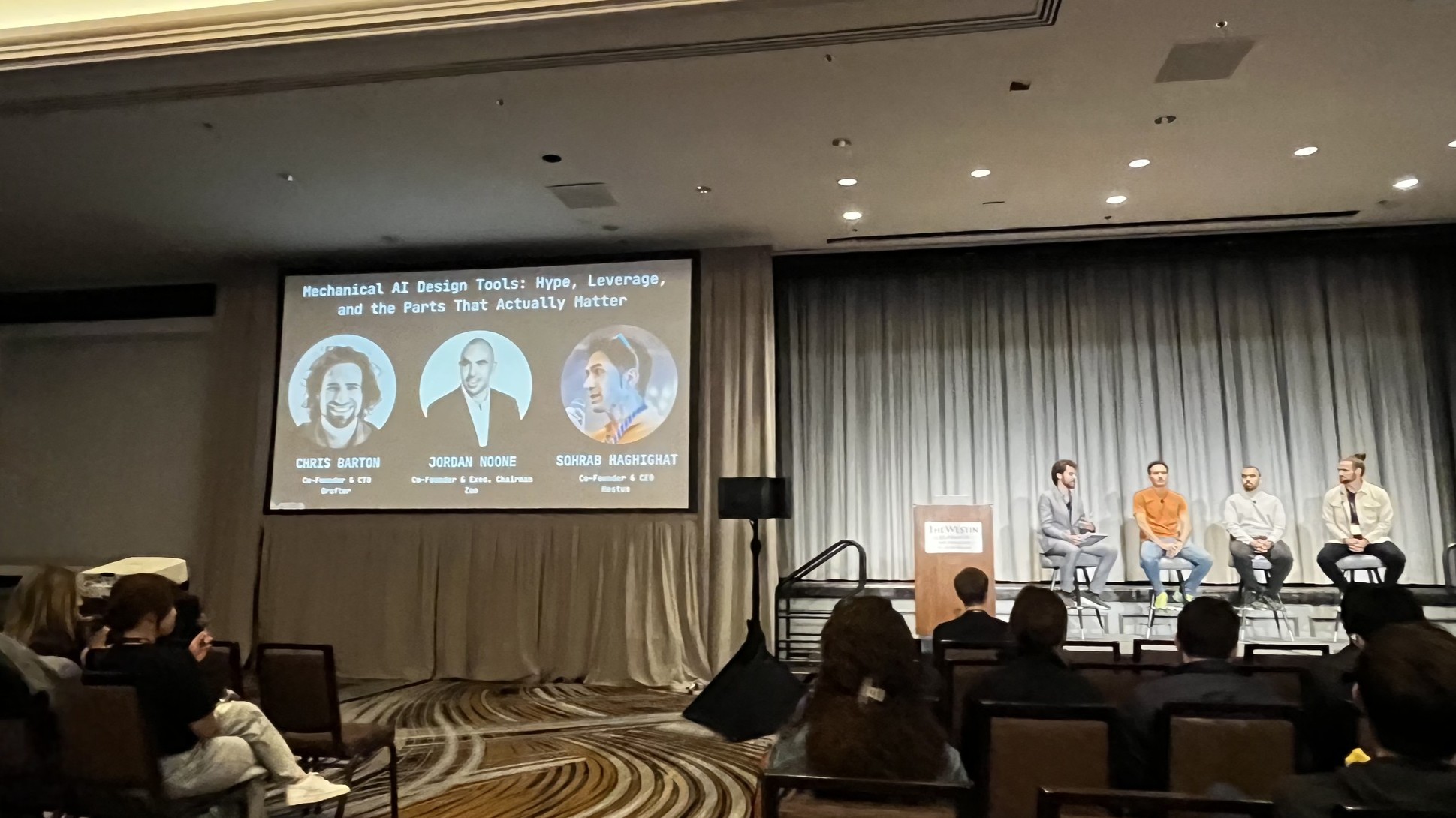 Panel: Mechanical AI Design Tools: Hype, Leverage, and the Parts That Actually Matter
A Return to Engineering
Em Moshouris, P.E. of WORC gave an interesting presentation sharing his view of engineering history. He noted that before the advent of CAD, design teams included both engineers and drafters. Engineers created concepts and applied science to develop designs, while drafters produced the documentation required for manufacturing. As CAD became more prevalent, drafting departments disappeared, and engineers took on both engineering and drafting work. Skill with CAD software should not be confused with good engineering. As Valentina Ratner of AllSpice.io stated, “the future of engineering is not drawing lines on screen.”
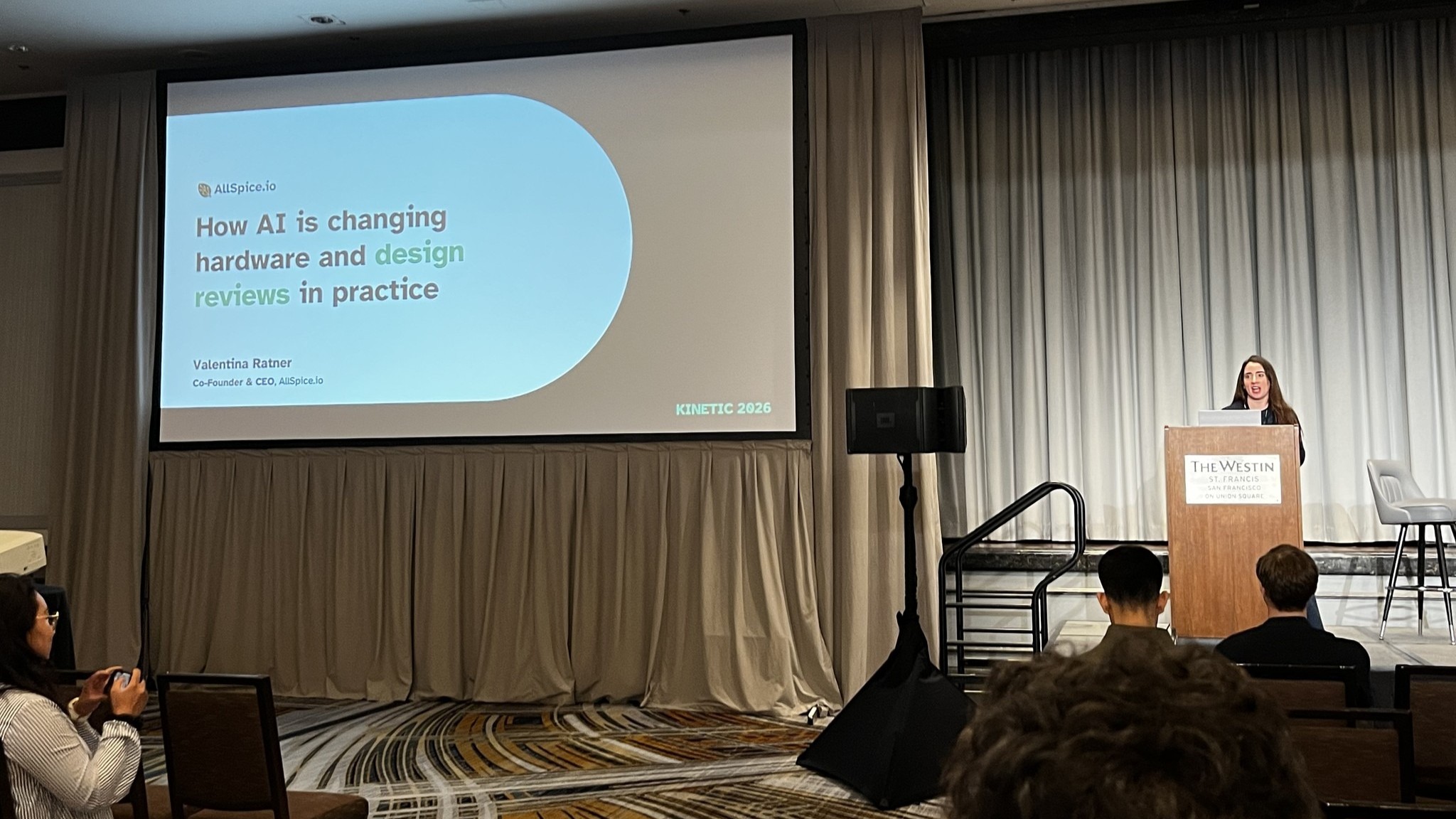
Valentina Ratner of AllSpice.io Presenting
Trust Is Earned
We’ve all seen examples of AI failure. In fact, on the way to day two of the conference, I experienced one firsthand when my Waymo got stuck behind a car that was illegally parked. In rush-hour traffic, there were no easy openings to merge into the next lane, and the AI was not bold enough to force the issue. At this point in the development of AI, it would be foolhardy to bet the enterprise on an AI tool. Because of that, many AI tool companies are focusing on areas where they can earn trust while keeping a human in the loop.
A low-risk area for AI integration is the design review process. Or Israel of bananaz discussed how the company’s tool can support mechanical engineering design reviews by checking against standards such as ASME Y14.5 for GD&T, as well as a company’s internal design guidelines. CoLab offers a competing product. On the electrical side, AllSpice.io supports both collaborative design reviews and AI-assisted review through its agent, DRCY.
Another area where AI tools can help is documentation generation. Filip Aronshtein of Dirac, Inc. described how BuildOS can take 3D CAD assembly files and automatically generate production-line assembly instructions.
Other companies are looking to help design engineers “shift left” with their workflow, pulling design concerns upstream and integrating them more tightly into the design process. Janus Juul Rasmussen of Component AI showed how their Codesigner tool can modify M-CAD designs for plastic-part moldability as the design is being developed. Noah Weber showed how Cosmon, Inc’s Nexus tool can link design and analysis tools into full engineering workflows.
Of course, the area of AI development receiving the most attention these days is generative design. Both Zoo on the mechanical side and Circuitly on the electrical side are tackling the generative design problem by using code to generate CAD designs. As we all know, LLMs are very good at code generation, so this approach aligns the problem domain with the tool’s strengths. If these companies are successful, hardware development may start to look a lot more like software development. Writing the part specification for the LLM could become the design engineer’s deliverable.
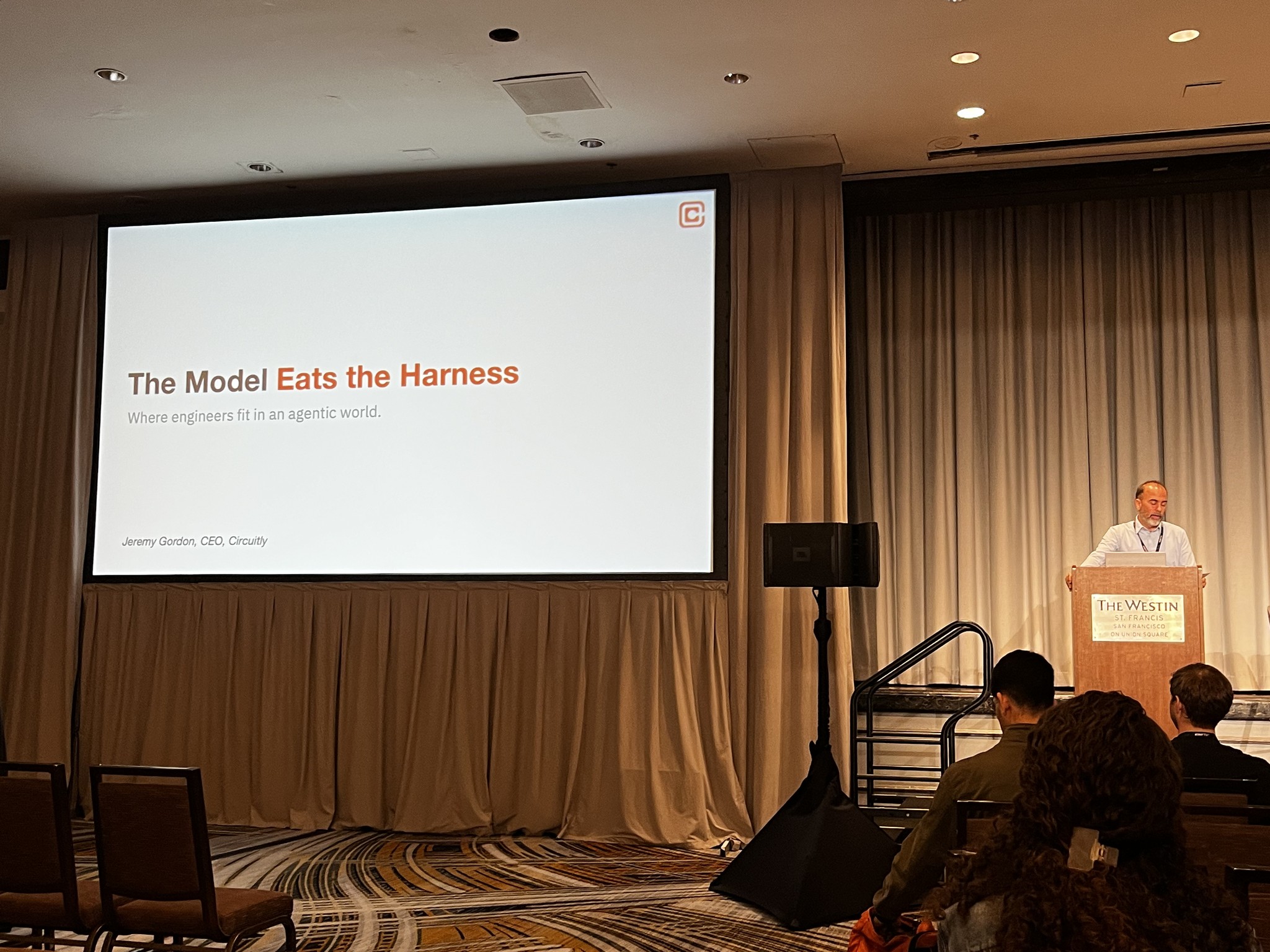 Jeremy Gordon of Circuitly Presenting
Deterministic vs. Stochastic
The last trend I want to share is the distinction between deterministic and stochastic tools. Several presenters raised this concept when discussing AI tools. If you’re not familiar with the terms, a deterministic tool returns the same result every time for the same inputs. Stochastic processes include some randomness. Generative LLMs actually inject random numbers into the process, so you will not get the exact same response twice. For engineering tools, this is a very important distinction.
The AI tool suppliers all discussed which parts of their tool chains were deterministic. Whenever possible, they used deterministic tools. Tasks such as file conversion and FEA are handled with deterministic methods because they require repeatable results and already have proven solutions. Deterministic tools also tend to be cost efficient. More complex problems without known deterministic algorithms are where AI shines. Per the old adage: use the right tool for the job.
The AI tool presentations at Kinetic suggest that the near-term impact of AI on hardware development will be about reshaping engineering workflows and letting engineers focus on the most important parts of the design. While I’m sure some jobs will be impacted, there is hope that the longer-term impact will trend towards greater and higher quality design output, not just fewer jobs. There are some great tools on the market already. I recommend that you analyze your engineering workflows to determine where these tools could provide business value.
 Software: Design Complete
 Hardware: Pre-production units for design verification
 MFG. Readiness: CM schedule and budget, Unit build tracking