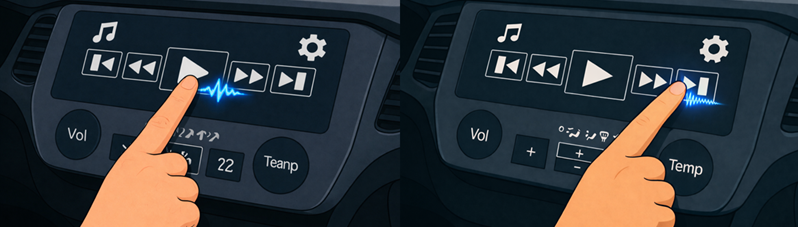
Piezoelectric materials have long played an essential role in modern electronics. Their defining property—the piezoelectric effect—allows specific crystalline and ceramic structures to convert mechanical stress into electrical charge, and conversely, electrical excitation into mechanical deformation. This dual capability forms the basis for familiar devices such as contact microphones, solid-state buzzers, and ultrasound imaging transducers. Across these applications, piezoelectric elements have been valued for their compactness, reliability, and ability to span wide frequency ranges with minimal moving parts. In recent years, piezoelectric materials emerged as compelling candidates for mechanical actuation in haptic interfaces. As consumer electronics have trended toward thinner form factors and tighter integration, traditional electromagnetic actuators such as eccentric rotating masses (ERM), linear resonant actuators (LRA), and voice-coil actuators (VCA) have increasingly struggled to meet constraints around size, bandwidth, and power consumption. Piezoelectric actuators—thin, efficient, and capable of high‑bandwidth mechanical output—offer a promising alternative for next‑generation tactile feedback systems.
Piezoelectric Actuators in Haptic Interfaces: A Brief Literature Review
Research interest in piezo‑based haptics extends back more than twenty years and has been driven primarily by two engineering challenges: achieving high spatial resolution and enabling high frequency operation.
Pasquero and Hayward’s STReSS system demonstrated a tactile display with one‑millimeter spatial resolution and a 700 Hz refresh rate—performance that required actuators with exceptional compactness and strength. The group achieved an individually addressable 10x10mm grid of tactile excitation elements for the human finger pad. Precisely machined piezoelectric elements were mounted in a tiny mechanical array, a form factor that electromagnetic actuators could not achieve. Winfield et al.’s T‑PaD system introduced ultrasonic vibration to modulate fingertip friction on touchscreens, enabling dynamically programmable textures. These ultrasonic effects required actuators capable of operating far above the bandwidth of traditional ERM or LRA mechanisms. Again, piezoelectric actuators were the natural choice due to their wide frequency response and high volumetric efficiency (even at ultrasonic rates). These academic efforts established piezoelectric actuators as uniquely suited for compact and/or high‑bandwidth tactile interfaces well before commercial adoption began. During the smartphone boom of the late‑2000s, companies such as Immersion, NXT, and Kyocera explored multifunction piezo actuators bonded directly to device structures, capable of producing both haptic sensations during touch and audio output when the user was not interacting—leveraging the same broad frequency response and compact form-factor highlighted in academic research.
It is clear from these three early piezoelectric embodiments that there were two major technical challenges that prevented widespread migration of piezoelectric actuators from acoustic applications into haptics. First, the manufacturing and sourcing of robust and customized piezoceramic actuators was not mature. And second, compact and highly efficient piezo specific driver ICs were not yet available. Both of these challenges have been largely resolved in recent years.
Embedded Button Panel — Piezo vs. VCA
To compare piezoelectric actuators with electromagnetic VCAs in a practical context, consider the design of an embedded button panel intended to deliver a crisp mechanical “click.” Prior work by Kaaresoja et al. shows that a convincing, high‑quality haptic click requires approximately 20 µm of surface displacement under the user’s fingertip, which typically corresponds to about 2 g peak‑to‑peak acceleration at typical effect frequencies between 150-250Hz. For this comparison, assume both a piezo actuator and a VCA are selected to meet this specification. With this baseline, we can contrast the two technologies across several engineering dimensions:
1. Piezoelectric actuators offer a significant advantage in volume and mechanical integration. VCAs require a magnet, coil, moving mass, and suspension system—components that impose minimum thickness and volume even for optimized designs. Piezoelectric actuators, by contrast, are thin ceramic‑polymer laminates that can be bonded directly to the chassis, button surface, or device structure without requiring an enclosed magnetic assembly. In many practical designs, a piezo actuator occupies roughly one quarter the volume of a VCA capable of producing equivalent effect intensity, making haptics feasible even in extremely space‑constrained devices.

Figure 1: Size Comparison between TEAX09C005 Electromagnetic Actuator in comparison with TDK B54102H1020A001 Piezoelectric Actuator.
2. Power consumption is another critical distinction. Modern piezo driver ICs from suppliers such as Texas Instruments, Analog Devices, and Boreas Technologies use efficient high‑voltage charge‑pump or boost topologies to energize the capacitive piezo load. Piezoelectric actuators are voltage-driven devices that create motion through an electrostatic material response, requiring only minimal current draw. VCAs, by contrast, can only generate force while current is flowing through resistive and inductive losses, which draws much higher currents—especially for short, sharp impulses. Furthermore, modern piezo drivers can recapture actuation charges, then store it for future effects.
3. Piezoelectric actuators also naturally double as sensors, generating measurable voltage in response to applied force or deformation. When integrated into an embedded button panel, the same piezo element can detect user touch, measure applied force, and trigger or modulate the haptic response. Electromagnetic actuators, by contrast, generate back‑EMF voltage proportional to velocity rather than displacement, making them unsuitable for sensing slow, damped fingertip interactions. The sensing‑plus‑actuation capability of piezos is particularly valuable in compact devices where minimizing part count is essential.
4. Piezoelectric actuator ICs, such as the Boreas 1921 (Left Below) are compact and require few support components. But conventional electromagnetic driver ICs have had many more years of optimization, are typically smaller, and require fewer support components. An example electromagnetic driver is the Texas Instruments TPA2036D1 (Below Right), which requires 5 external components and is available in a 1.45×1.45mm package. By contrast, the piezo driver IC is a 4.0×4.0mm package, and requires 8 support components. Thus engineers must trade-off increased pcb area and component costs against the mechanical, power, and sensing benefits that piezoelectric actuators offer.
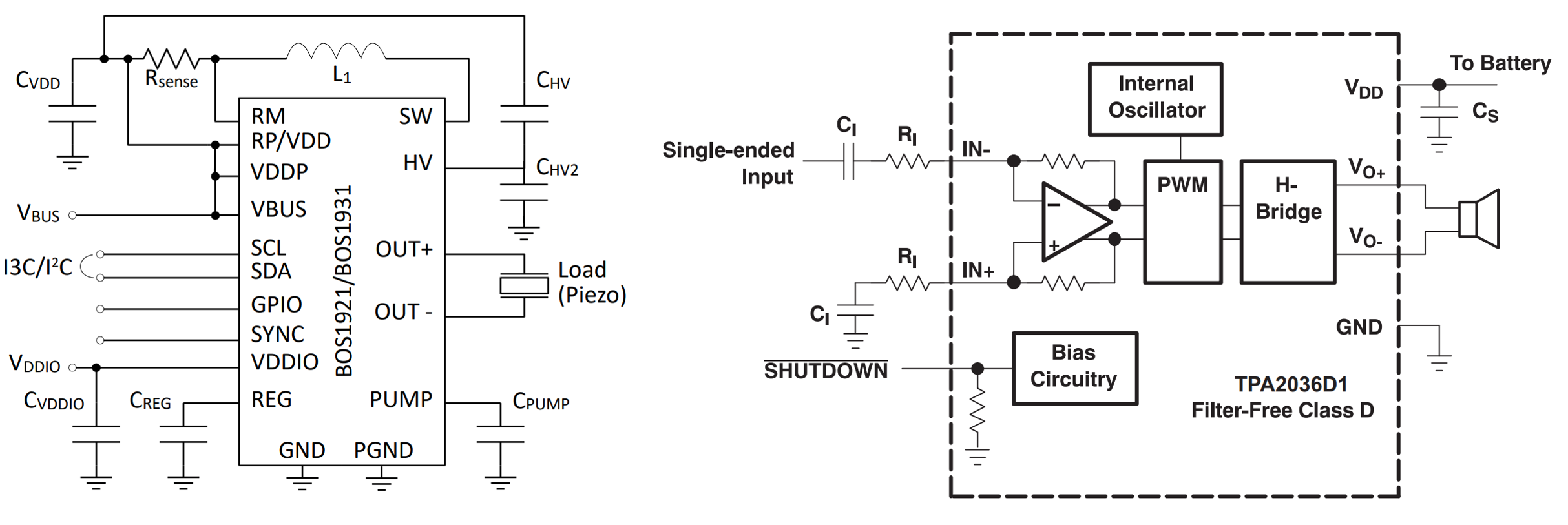
Figure 2: Boreas 1921 typical circuit (left) and Texas Instruments TPA2036D1 typical circuit (right).
Conclusion: Piezoelectric Actuators for Embedded Haptics: A Practical Engineering Comparison
Piezoelectric actuators are not a universal replacement for all haptic technologies, but they excel in scenarios where size, bandwidth, and energy efficiency matter most. They are particularly well suited for ultra‑thin devices, embedded or perimeter‑mounted buttons, wearable systems with strict power budgets, and interfaces that benefit from combined sensing and actuation. Their broad frequency response also enables multifunction designs in which the same actuator can produce both tactile feedback and audible sound.
As driver technology improves and integration practices mature, piezoelectric haptics are transitioning from research prototypes into mainstream engineering solutions. For designers seeking high‑performance tactile feedback in compact and power‑sensitive consumer electronics, piezo actuators offer a compelling and increasingly practical option.
Piezoelectric haptics are moving from niche applications into practical, high-performance solutions for compact, power-sensitive devices where traditional actuators fall short. If you have a haptics challenge to solve, contact us to connect with our engineering team to accelerate your path to production-ready tactile performance.
 Software: Design Complete
 Hardware: Pre-production units for design verification
 MFG. Readiness: CM schedule and budget, Unit build tracking