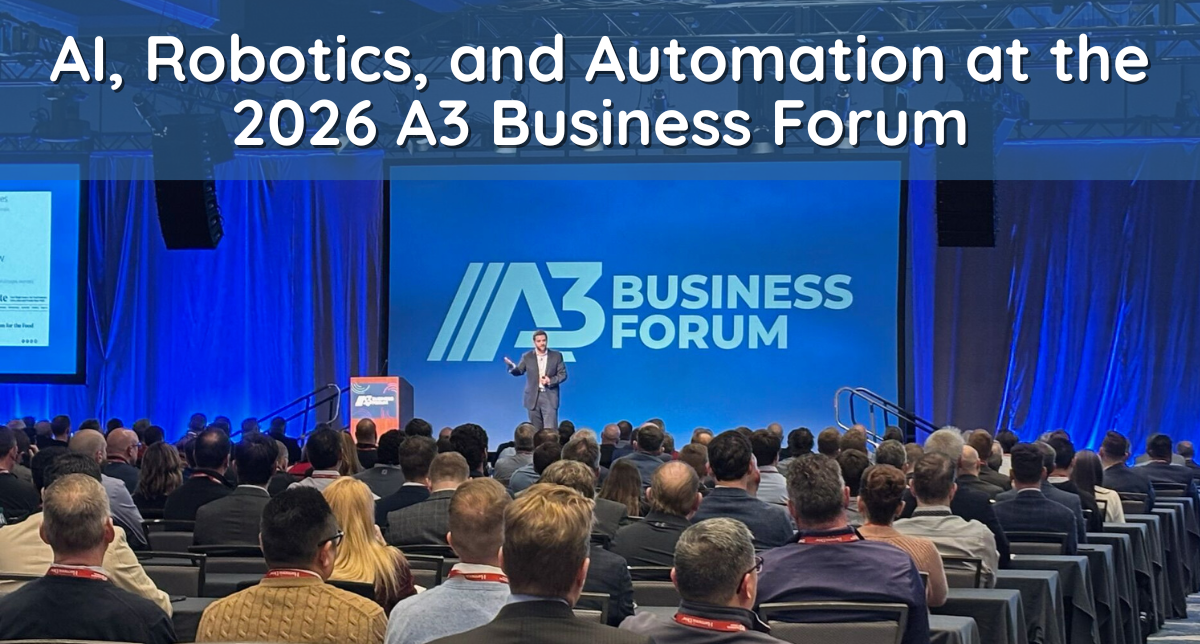
The annual A3 Business Forum is a premier networking event for leaders across the automation and robotics industries, hosted by the Association for Advancing Automation (A3). This was my second time attending, and once again it proved to be an incredible opportunity to explore emerging trends while connecting deeply with the thought leaders shaping the future of AI, robotics, and automation.
The event is exceptionally well executed. The A3 team runs a tight, seamless operation from organized logistics and spectacular food to thoughtfully designed networking opportunities. The speakers were engaging and genuinely thought-provoking, and the attendees brought an openness and collaborative spirit that made every conversation feel natural and energizing. Nothing about the experience is forced; it’s organic, inspiring, and truly invigorating. You leave feeling hopeful, connected, motivated, and changed.
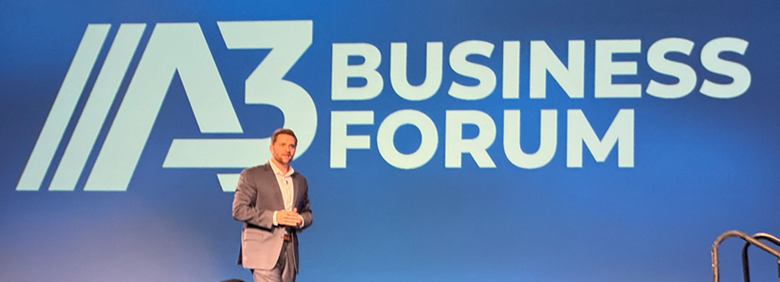
Opening on Martin Luther King Jr. Day added an especially meaningful touch. Executive Vice President Alex Shikany honored Dr. King before introducing the first keynote speaker, a fitting and grounding start to an incredible event.
Monday Opening Keynote: Turning Challenge into Opportunity and Change into Competitive Advantage
In the opening keynote, Turn Challenge into Opportunity & Change into Competitive Advantage, Peter Sheahan—Group CEO of Karrikins Group and one of the National Speakers Association’s 25 Most Influential Speakers in the World, shared powerful insights on leadership in times of disruption. Drawing on his work with global brands such as Apple, Hyundai, Goldman Sachs, and IBM, Sheahan focused on how organizations can find opportunity amid rapid marketplace change.
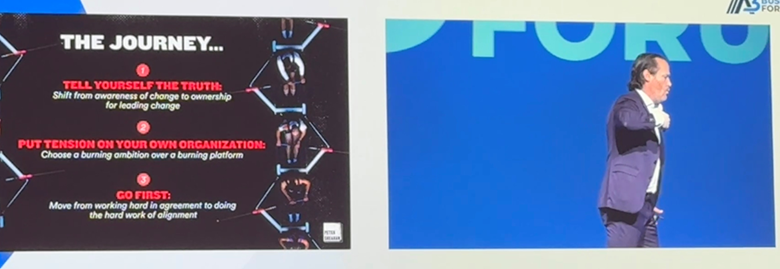
Sheahan emphasized that true transformation starts with leaders, not companies, and outlined a three-part framework for leading meaningful change:
1. Tell Yourself the Truth
Shift from mere awareness to true ownership.
- Leaders often struggle more with moving from awareness to ownership than from ownership to action.
- Experience, while valuable, can also turn into baggage if not examined carefully.
2. Put Tension on the Organization
Choose a burning ambition over a burning platform.
- Great leaders guide customers toward the future, instead of reacting to their needs only after the fact.
- Most lost value comes from senior leaders clinging to defensive, legacy strategies.
3. Go First
Move from working hard in agreement to doing the hard work of alignment. Leadership requires modeling the behaviors and attitudes needed for the organization to truly change.
Key Takeaways
This keynote reinforced the importance of adopting a growth mindset and avoiding the experience trap—the tendency to rely too heavily on what has worked before. Going forward, this means:
- More actively checking and challenging assumptions.
- Prioritizing offensive strategies and KPIs over defensive ones.
- Spending more time anticipating where customers are headed—and getting there first.
Now onto Tuesday….
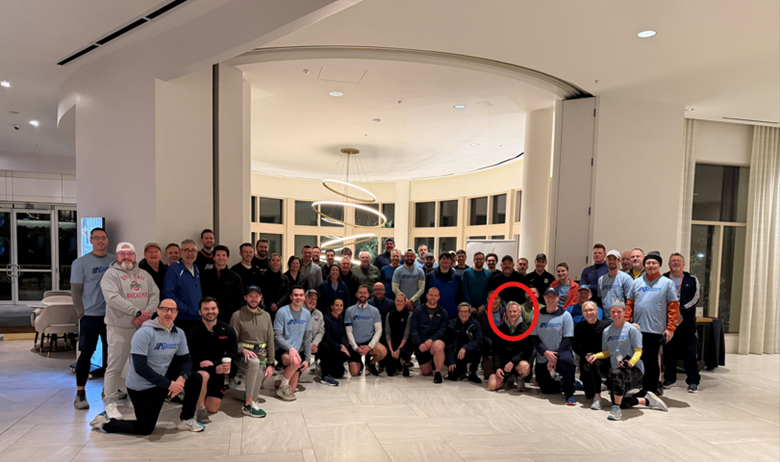
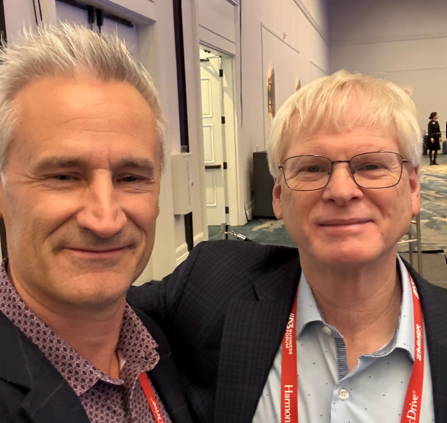
Day two of the event started with a 5k walk run event at 6:15am with temperatures in Orlando unseasonably cool at 35 degrees. This was a healthy way to get the day started! I crossed paths with Jeff Burnstein, President of A3, and he and I chatted about robotics, automation and government policy for our 45minute walk.
Keynote: Importance of ITR Economics’ Outlook for 2026 and Early 2027
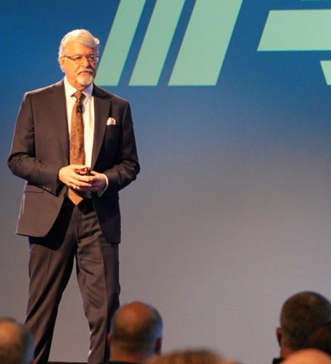
In previous years, Alan Beaulieu, former President of ITR Economics, delivered the keynote on the state of the economy and the future outlook. With Alan’s retirement last year, his brother Brian Beaulieu, CEO of ITR Economics, stepped in to update us on past forecasts and what the next decade is likely to hold.
Overall, the next several years are expected to bring continued growth, though Brian noted that some mild turbulence may emerge in the latter part of 2026. Even so, the broader outlook remains strong through the early 2030s. In line with earlier projections, Brian reiterated the expectation of a significant economic downturn in the mid‑2030s.
A key takeaway for business owners is the concept of entering a period of “profitless prosperity.” Brian emphasized the importance of effectively passing along price increases and staying intensely focused on margins. He also highlighted that inflation will remain persistently high over the next three to five years. Several factors are driving this trend, including an anticipated 20% rise in wages by the end of the 2020s and ongoing labor shortages across the U.S.
Panel: Executive Roundtable – Technology, Trends, & What’s Ahead for 2026
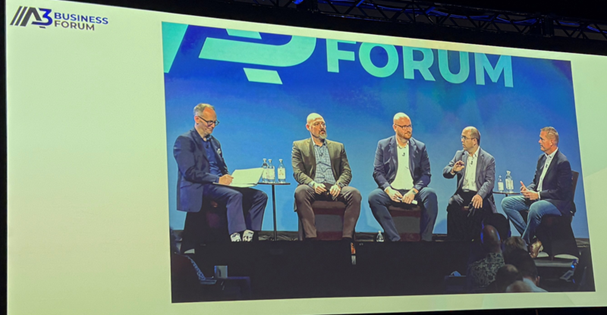
This panel featured several outstanding industry thought leaders, including Mike Cicco, President and CEO of FANUC America; Robert Huschka, VP of Education Strategies at A3; Andre Marino, SVP of Industrial Automation at Scheider Electric; Gabe Zingaretti, COO of Osaro; and Johannes Zürin, CMO of Allied Vision. Key insights from the discussion included:
- AI‑enabled robots show the greatest near‑term potential in logistics, where dynamic, unstructured environments create significant opportunities for automation.
- AI is generating excitement as a potential “iPhone moment” for the industry—yet despite rapid development, real‑world adoption and deployment in robotics remain comparatively slow.
- There is a clear shift toward decoupling hardware and software, moving the industry toward more open, interoperable ecosystems rather than closed, proprietary ones.
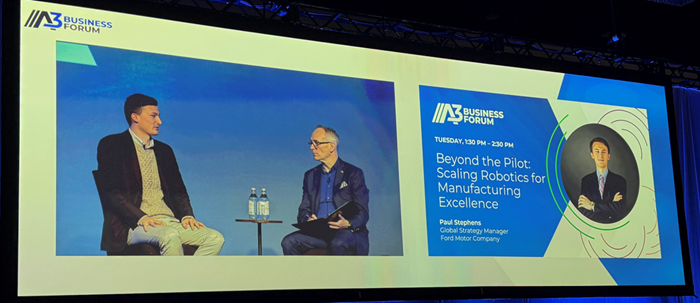
Tuesday: Beyond the Pilot: Scaling Robotics for Manufacturing Excellence
Paul Stephens, Global Strategy Manager, Ford Motor Company walked the audience through a series of questions, probing at how Ford thinks about robotics and automation and how system integrators can participate in solutions at Ford.
Key themes include:
- Technology focus and strategy:
The company sees strong value in robotics, particularly autonomous mobile robots (AMRs), cobots, and physical AI. Rather than chasing hype (e.g., humanoids), it prioritizes practical use of existing, proven technologies and incremental gains, especially in last-mile and brownfield (legacy) environments. - Pilots and adoption challenges:
Many pilots fail due to misaligned expectations, unclear requirements, and underestimating facility, people, and integration needs. Responsibility lies with both customers and vendors. Successful pilots require transparency, realistic scoping, and deep engagement with frontline workers and unions. - Human-centric deployment:
Adoption improves when workers are involved early and feel ownership of the solution. Technologies that augment people (e.g., AI vision, wearables, decision-support tools) often scale faster than robots working directly alongside humans. - Integration and openness:
Open architectures, standard communication protocols, and interoperability are critical. Vendors that resist openness or industry standards risk being excluded, regardless of past relationships. Integration partners play a vital role, as large manufacturers often lack the specialized expertise to self-integrate complex autonomous systems. - Ecosystem and partnerships:
Success comes from combining innovative startups, experienced integrators, and large industrial players. Proactive integrators who scout new technologies and package them into ready-to-deploy solutions create the most value. - Scaling vs. hype:
The biggest challenge is industrializing promising technologies—making them robust, low-maintenance, and reliable in dirty, dynamic plant environments. “Babysitting” technology negates its value. - Investment and ROI models:
Flexible financial models (e.g., robot-as-a-service, leasing) improve ROI and speed adoption. Shifting automation from capital expenditure to operating expense has helped unlock faster scaling. - Future outlook:
Over the next few years, autonomous robotics will move toward more dynamic, flexible, software-driven plant ecosystems (akin to “Google Maps for intralogistics”). Advances in AI and software will be key enablers.
Presentation: Collaboration & AI Automation
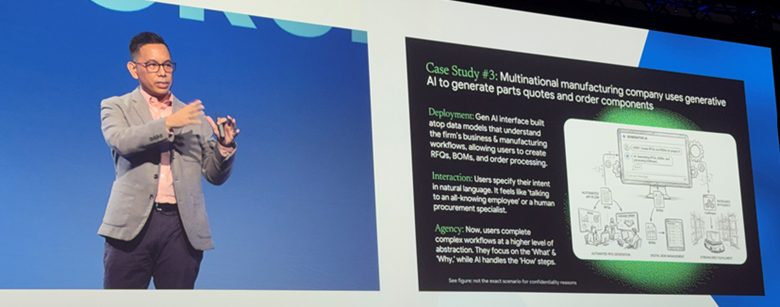
The presentation, delivered by Google researchers including Anoop Sinha and Renelito Delos Santos, explores how AI adoption is accelerating across organizations and how its success depends on effective human AI collaboration. Drawing on two major research studies and several case studies, the speakers presented a case that AI not only improves system capabilities but can also increase human agency—people’s sense of competence, control, and possibility. Key themes include:
1. AI Adoption and Business Impact
- A global Google Cloud survey of manufacturing executives found that over half are already seeing ROI from advanced AI.
- Reported benefits include productivity gains (75%), improved customer experience (64%), business growth (60%, though declining year-over-year), marketing support (58%), and security improvements (53%).
- Despite strong adoption, achieving consistent topline growth remains challenging, highlighting the complexity of AI deployment.
2. Human Agency and AI Use
- A second ethnographic study by Google Jigsaw and partners examined heavy AI users across multiple countries.
- Contrary to widespread concerns that AI reduces human control, heavy users reported increased agency.
- Researchers identified five dimensions of agency enhanced by AI:
-
- Instrumental (getting tasks done faster)
- Cognitive (organizing and clarifying thinking)
- Emotional (managing stress and mental states)
- Relational (improving interactions and collaboration)
- Structural (AI embedded into organizations and institutions as a core interface)
3. Manufacturing Case Studies
- Quality inspection: An AI vision system paired with human inspectors reduced defects by over 50%, demonstrating the value of human–AI collaboration rather than full automation.
- Fabrication guidance: A real-time, video-based AI system guided technicians during complex work, cutting processing time by about 10% and increasing worker confidence.
- Quoting and business insights: A generative AI system enabled faster, more accurate part quotations and broader access to organizational intelligence through natural language queries.
Key Takeaway:
AI delivers the greatest value when designed as a collaborative intelligence layer that people across an organization can easily access. When deployed thoughtfully, AI not only improves efficiency and outcomes but also enhances human agency, confidence, and capability across work, education, and society.
Keynote: From Customers to Superfans: Creating Loyalty Through Standout Experiences
Brittany Hodak, Customer Experience Keynote Speaker and Author of Creating Superfans, took us on an incredible journey to close on the second day of the conference.
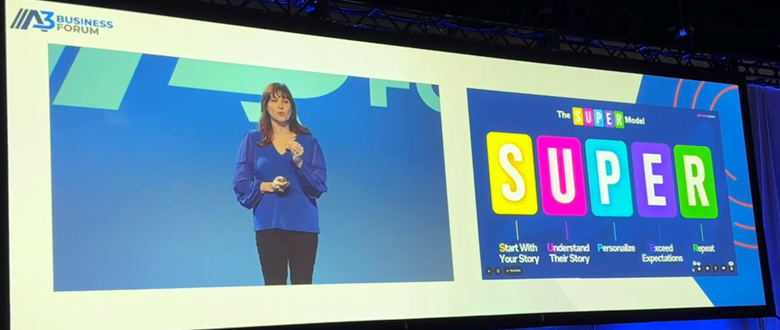
Brittany explained that every business is fundamentally in the experience business and that customer experience—not just products or services—is the biggest differentiator today. From the world’s oldest customer complaint (a 4,000-year-old tablet) to modern AI expectations, customer behavior has changed technologically but not emotionally: people want to feel respected, understood, and valued.
Customers now compare every interaction to the best experiences they’ve ever had anywhere, not just to competitors. Most experiences are neutral, which leads to apathy, the biggest hidden threat to businesses. Customers who feel neutral won’t complain, but they also won’t advocate.
The goal, therefore, is to create superfans: customers or partners who are so delighted by their experience that they become enthusiastic advocates. Superfans generate higher-quality referrals and loyalty, far outperforming traditional marketing. You can’t buy superfans—you earn them through intentional experience design.
Brittany introduced the SUPER framework for creating superfans:
- S – Start with your story: Clearly articulate what makes you different and why you matter. Stories drive connection better than specs or data.
- U – Understand their story: Deeply understand customer needs, goals, and hidden pain points so you don’t create new problems while solving old ones.
- P – Personalize: Combine high-tech automation with high-touch human moments so customers feel individually valued.
- E – Exceed expectations: Intentionally elevate moments that are usually neutral or negative into memorable positives.
- R – Repeat: Continuously refine and improve; consistency compounds and builds trust over time.
Examples from companies like Disney, Apple, Southwest, and Chewy show how small, thoughtful details such as personalized emails, proactive care, and emotional gestures create powerful advocacy at little extra cost.
The core message: every touchpoint communicates. When businesses choose “super” over standard, they reduce customer apathy, inspire loyalty, and turn customers into advocates who speak for them in rooms they’re not in.
Wednesday Keynote: What Comes Next: Navigating the Kaleidoscopic Futures of AI and Security
Dex Hunter-Torricke, Emerging Technologies Expert and former communications executive at Google, SpaceX & Facebook, kicked off day three and argues that AI represents a once-in-a-civilization transformation, not incremental automation. Drawing on experiences from Google DeepMind, the UN, and Silicon Valley, Dex frames AI as a force reshaping trust, security, resilience, economies, culture, and geopolitics—simultaneously creating extraordinary promise and unprecedented disruption.
At the optimistic end, AI could unlock breakthroughs such as nuclear fusion, clean and abundant energy, desalination at scale, post-scarcity economics, space exploration, radical medical advances (e.g., protein folding via AlphaFold), faster scientific discovery, new materials, longer lifespans, autonomous transport, and entirely new forms of culture and entertainment. AI’s “kaleidoscopic effects” mean progress in one domain cascades into many others, accelerating change far beyond linear expectations.
At the same time, Dex emphasizes that disruption is real and already happening. Millions of jobs are being transformed, industries from education and architecture to manufacturing and logistics are being restructured, cities may be redesigned around autonomous vehicles, and global competition is intensifying, especially geopolitical and supply-chain tensions Climate change, energy consumption from data centers, and public distrust of AI compound these challenges. Polling shows most people feel pessimistic about the future and skeptical of AI, signaling a crisis of trust rather than simple lack of education.
The core thesis is that the future is not predetermined or linear; it is shaped by choices. Technology does not arrive in isolation—it collides with society, politics, culture, and the environment. Leaders, innovators, and technologists must therefore think holistically, plan for second- and third-order effects, build trust through responsible deployment, and develop personal and organizational strategies for constant reinvention.
Dex closed his keynote by placing today’s moment in historical perspective: the last century transformed life from the Model T to spaceflight and the internet. The next century—driven by AI will be far more dramatic. Those building AI today are compared to the engineers of the Industrial Revolution, with a responsibility to ensure these technologies are managed well so future generations inherit a better, not worse, world.
Keynote: The Latest Automation Statistics, Trends, & Key Market Drivers
Alex Shikany, Executive Vice President, Association for Advancing Automation (A3) provided insight into what the industry has done in 2025 and a look ahead to 2026. Key findings include:
Smart manufacturing, automation, and AI adoption are accelerating, with over 90% of manufacturers believing these technologies will drive competitiveness, transform production, and improve resilience by 2026.
The robotics market rebounded in 2025, led by strong growth in general industries, food/consumer goods, and a strong Q4, signaling recovery from recent inventory and supply chain softness.
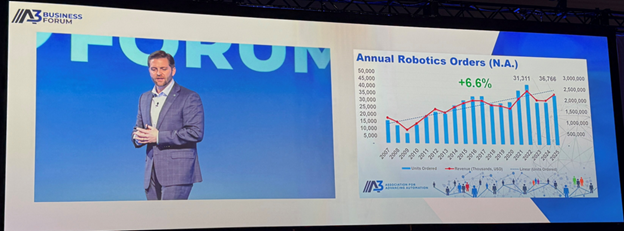
Collaborative robots are gaining traction outside automotive, with general industries now the largest adopters, highlighting diversification of robot use cases.
Industry sentiment for 2026 is optimistic, with most companies expecting revenue growth, increased hiring, and greater investment in AI, digital twins, machine vision, and motion control technologies.
Automation is increasingly viewed as a workforce enabler, not a job destroyer, with growing acceptance that humans and machines will work together to address labor shortages and boost productivity.
Conclusion: AI, Robotics, and Automation at The A3 Business Forum
There’s so much to be grateful for when reflecting on this conference. I can feel a real momentum for change building within me. I’m thankful to A3 for bringing together such an exceptional lineup of speakers and thought leaders—and to those individuals for generously sharing their time, their insights, and messages of change, hope, and a brighter future.
Without this event, meeting the titans in the industry, like Robert Little and Jeff Burnstein would have been much harder. Leaders like them open hearts and minds to others, and that spirit is exactly the kind of future I want to see for this industry.
Simplexity has a strong path ahead, and our team is energized and ready to be part of this next chapter.
 Software: Design Complete
 Hardware: Pre-production units for design verification
 MFG. Readiness: CM schedule and budget, Unit build tracking